Monday, April 13, 2015

Living Here is a Blast; or More About the Volcano

It is so interesting living next to a volcano.  Every morning we look out the window to see which way the ash is blowing.  We hope that it is blowing out to sea, but several times a week it blows toward us, leaving a thin (sometimes thick) layer of ash on cars, plants, roads, etc. It’s like tiny gritty bits of glass.  People often wear medical face masks because of it.  I picked up a couple of chunks volcanic rocks, and got a glass sliver in my finger.  Note to self: wear work gloves.
 

We looked up some facts, and in general, the volcano erupts once every 4 to 24 hours.

In the 1970’s it erupted once a day.

In the 1980’s one or two per day, with volcanic bombs, some damage to cars and houses.

In 1995 there were long pauses, several days between explosions.

2000 to 2005 were 150 to 200 eruptions per year.

2006 to 2010 erupting between one to five day intervals. 

2015 March 16, one plume rose 14,000 ft. above the crater.

2015 March 18, ten eruptions

2015 March 27, 14 eruptions, one plume rose about 13,000 ft., and is in a very active phase.


Any country has challenging environmental things, such as tornados, hurricanes, earthquakes, volcanos, etc.  The important thing is to be alert and aware of our surroundings.  Our church has encouraged us to have an emergency preparedness backpack with some money, food, change of clothes, first aid kit that we can grab and run, if necessary.  We are also encouraged to have a good storage supply of water and nonperishable food.  “If ye are prepared, ye shall not fear”.  (D&C 30:30) This gives us great comfort.  Aren’t we all in the Lord’s hands wherever we are anyway?  We will trust Him.


Here are some of our favorite photos of the volcano:


Monday, March 23, 2015

The Harbor View

We recently had a fun adventure.  We dropped the two zone leader elders at the harbor so they could take an overnight ship to visit the elders twelve hours away in Naze on Amamioshima Island.  There’s a large floor sleeping area below deck, so they “camp out” for the night.  The winds were very strong, but they made the trip back and forth safely. 

We also walked along the sea wall path.  It was beautiful, with palm trees and a setting sun.  We felt like we were in some “dreamy” faraway, exotic place.  Wait a minute . . . we are in a faraway place—Japan!

It was also interesting to see the volcano from a different view. 

The weather was funny this week.  It was sixty degrees one day, and two days later forty degrees and snow flurries.  Several days after that we had volcano “ash and rain.”  (Some call it Haiame.  Hai is volcanic ash, and ame is rain).  We couldn’t see out of the car windows because of the muddy rain.  We had to wipe them off several times. 

 
A panoramic view of the walkway.


The elders and the friends they already made on the ship before departing.
 
 
Leaving the dock. 
 
 
The ferry passing in front of the volcano. 
 
 
Looking back at Kagoshima City from the harbor.

Sunday, March 8, 2015

The Volcano's Influence

The volcano, Sakurajima, is such a big part of the tourism and the culture of this Kagoshima area.  It is always on people’s minds as it looms so largely on the landscape from almost every angle.  And we think about it each morning as we look out our window to see which way the ash is blowing or just to see how the sunlight and shadows will play on it, hour by hour during the day.  One person told us recently that when she sees it in the morning she is grateful for one more day of life.  Images of the volcano seem to be everywhere on logos for businesses, calling cards, billboards, and most things that are products of this area.  It appears in a lot of artwork.  We recently attended a Japanese Washi Paper Art Exhibit, which was amazing, but we were struck by how many of these beautiful pieces of delicate art had the volcano in them.  (Washi paper is a very fine colored paper which is torn into very small fine pieces and pasted on to make the picture.  Even the small leaf veins portrayed are individual threads of fine paper).  As you look at it each day you can’t help but think of the beauty and power of nature, and for us the awesome power of God’s creations.  We too are grateful for one more day, to share God’s love for the people here.

 
A Stained Glass Piece of Art in the Shinkansen Train Station. 

 
The entrance to one of the tunnels on the freeway into the city.

 
Japanese Washi Paper Art.


A view of the volcano from our church this past week. 

Monday, February 16, 2015

Strawberries and Gomi

Recently the English class coordinator for the city Volunteer Center invited us (six missionaries) to go with her to pick strawberries.  We were so surprised.  It’s winter, we’ve had a little snow, where would we find strawberries? We carpooled with a group of people from our English class, drove for about an hour, went up into the mountains, and by some farms.  We arrived at a beautiful farm with rows of green houses, full of strawberries.  The owner did an orientation, and let us sample their berries.  They were some of the sweetest berries we had ever tasted.  He handed us little baskets, little scissors for cutting the berries, and let us choose the berries we wanted.  The berries were easy to find, because they were hanging off the side of the growing racks, with all the varieties labeled.  We took our filled baskets to their store/office, they weighed the berries, we each paid for our berries, then headed the hour drive back to town.  I don’t want to make that drive very often, but the berries and the good friends made it well worth the drive.


“Gomi” is a cute Japanese name for garbage. Garbage is a complicated thing in Japan.  Everything has to be rinsed, sorted, tied, or bagged in transparent plastic bags.  You take something out each of the five week days. Each day is a different group, since they sort into several categories for recycling—burnable (kitchen scraps/yard scraps), plastics, newspapers, etc. etc. We receive a “garbage” calendar, which helps to remember what to take out each day.  It is all in Japanese/kanji, but luckily we have an English translation paper for the categories.  Each evening before going to bed we get the gomi ready to take out the next morning.  We try to stay on top of it so we don’t have garbage build up.  There are gomi drop-off points on every block.  They have a green net to cover the gomi so the crows don’t get to it.  It is all very neat and organized. 
 
 
The garbage trucks are neat, clean, and kind of cute.

 
This is the neighborhood drop point, every couple of blocks.

 
This is an extra big pile before the New Year's break.


Sunday, February 8, 2015

A Week of Miracles


We came to Japan with International Drivers Licenses but are legally required to get Japanese licenses within a couple of months, if staying for an extended time.  We had been putting off getting them because we understood it was very hard and very expensive.  After gathering up all of our legal papers and previous licenses we made a couple of trips to the DMV testing center about fifty minutes away from our home in another town.  We found the testing and processing people to be very helpful, friendly, and kind.  We are so blessed to be able to say we got our drivers licenses.  Now we can focus on other things that need to be done, like learning Japanese. 
 
 
The test range.

 
The miracle licenses. 
 
We have also met a lot of wonderful new friends.  Many have started coming to church and to our dance exercise classes.  The members and our friends seem to love the exercise class and say they want to come every week.   We had thirty people come to the class this past week.  People in their twenties, thirties, forties, and fifties have been coming.  It makes this sixty-five year old instructor feel pretty good.  We get a chance to share a short gospel message at the end which they also seem to enjoy.  We love sharing these good things.

Sunday, January 25, 2015

Apartment Inspections

One of the things we get to do every six weeks is drive around our zone and visit the apartments of all of the missionaries.  There are eight apartments in our zone.  It takes us several days to see them all since five of the eight are an hour to two hours away.  We drive through some beautiful mountains to get to the most distant areas, so other than the stress of driving in Japan, it is enjoyable to see the countryside.  And the missionaries are awesome.  They are so focused and working so hard, come rain or shine, snow, sleet or hail, heat, or volcanic ash, they are out trying to find people with whom they can share the message of the gospel.  When we visit their apartments we try to see if there are things in their apartments that need replacing or broken, and encourage them to keep them well organized and clean.  You gotta love them!  We have had refrigerators go out, washers causing problems, and broken desk chairs and light switches, etc.  The missionaries do a wonderful job and they treat us so well when we come too.  We always try to bring them some kind of fruit or treat for doing a good job, but some have insisted on fixing a lunch for us.  Along the way we see some interesting things. 
 
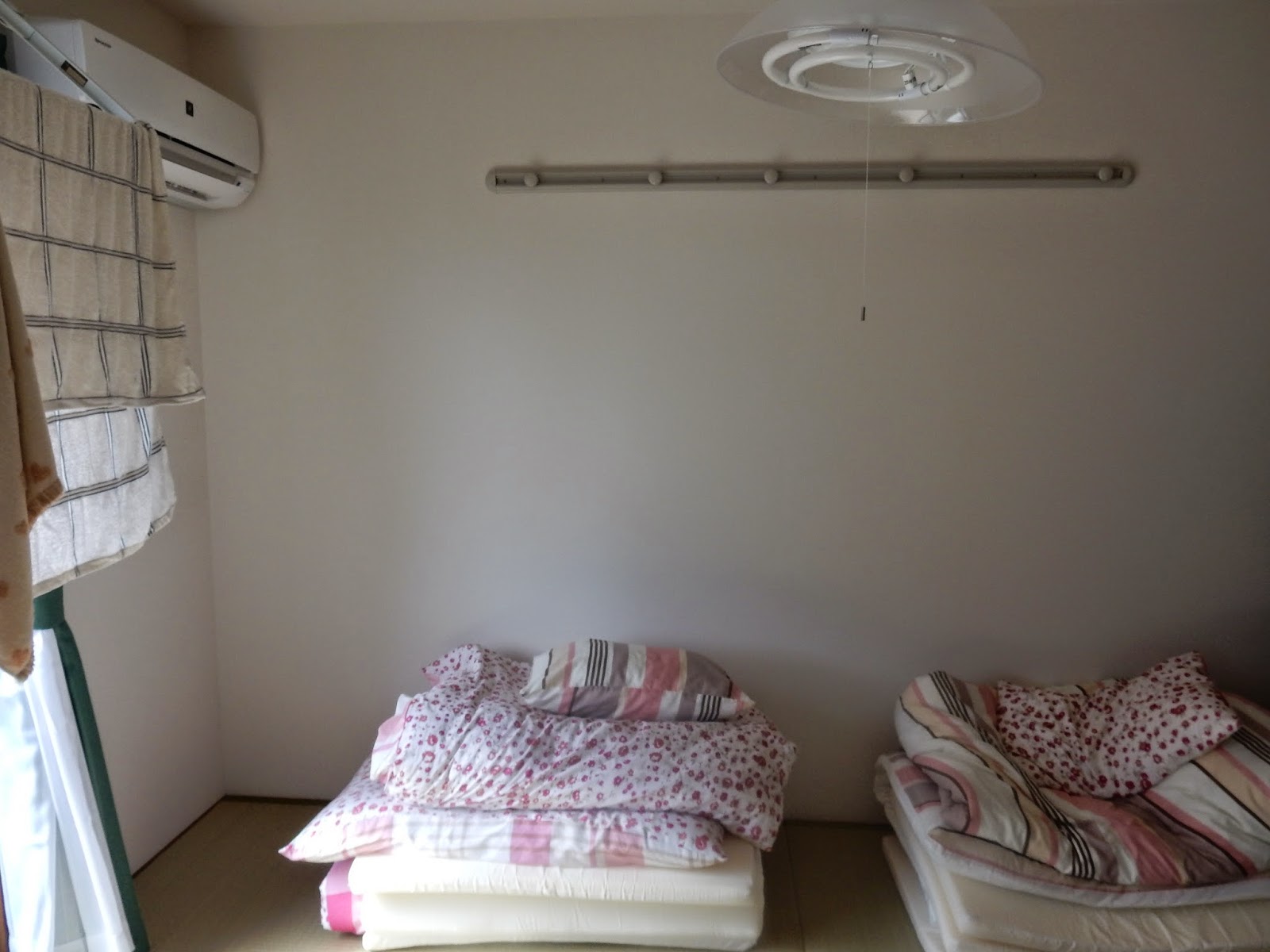
Most missionaries sleep on the floor in futons. 

 
Their kitchens are fairly simple. 

 
A small washer is often in bathroom and shower area.

 
Some of them live in fairly tall five or six story buildings.
 
 
Cutting the sides of hills and mountains is so methodically and artistically done here. 

 
Sometimes the roads are foggy. 

 
One of the messages hanging in a missionary apartment to encourage them in their labors.

 
The ever present 7-11.  Actually has an ATM where we can withdraw money from home.

 
Some apartments are a little lower.  They are to air out their futons often by hanging them outside.

 
Yes, we also see missionaries on their bikes with their white helmets.
Yes mom, that is how wide the roads are that they are riding on! 

 
Road construction flag man.  Can you tell which is real and which is mechanical?


Friday, January 2, 2015

New Year's 2015 in Japan

Happy New Year!  Can you believe it’s already January 2, 2015?  Sometimes the days seem long, but the weeks and months seem so short. 

New Year’s is interesting in Japan.  Japan is basically a Buddhist and Shinto country with a few Christians and other religions.  It was interesting that Christmas decorations starting going up after Halloween.  They don’t trick-or-treat but the stores decorate with pumpkins and Fall colors.  So for two months we enjoyed Christmas music and decorations around town.  Within a day after Christmas all of those decorations were replaced by New Year’s decorations.  Businesses and government buildings are closed on the 1st, 2nd, and 3rd.  Stores have now started opening on New Year’s day to compete for shoppers.  The families have special meals with food only served at New Year’s.  “Hatsuihinode” (viewing the first sunrise) is the first activity of the New Year.  They also have the first writing, Kakizome, the first food, and other things.  It’s quite a time for family gatherings.  They go together to visit the shrines to remember their ancestors and say prayers for good fortune and health in the new year.  It’s a fun time to be in Japan.  This is our fourth New Year’s together in Japan, and each time it has been fun to watch.  What a great place to live and what great people! 


First sunrise, blocked by the rain and snow.
 
 
Some of the New Year's decorations, the braided straw ropes over the doors to bless the homes and buildings, and those who enter.  It's the "year of the sheep". 


Crowds gathering at the shrines on January 1st to pay respect.
 
 
Oseichi special foods for New Year's week. 
 

First snow of the new year--it was a cold, wet day here.